
eoConfig
Updated: Sep 23

Configuration tool for EM-field measurement using Kapteos instrumentation
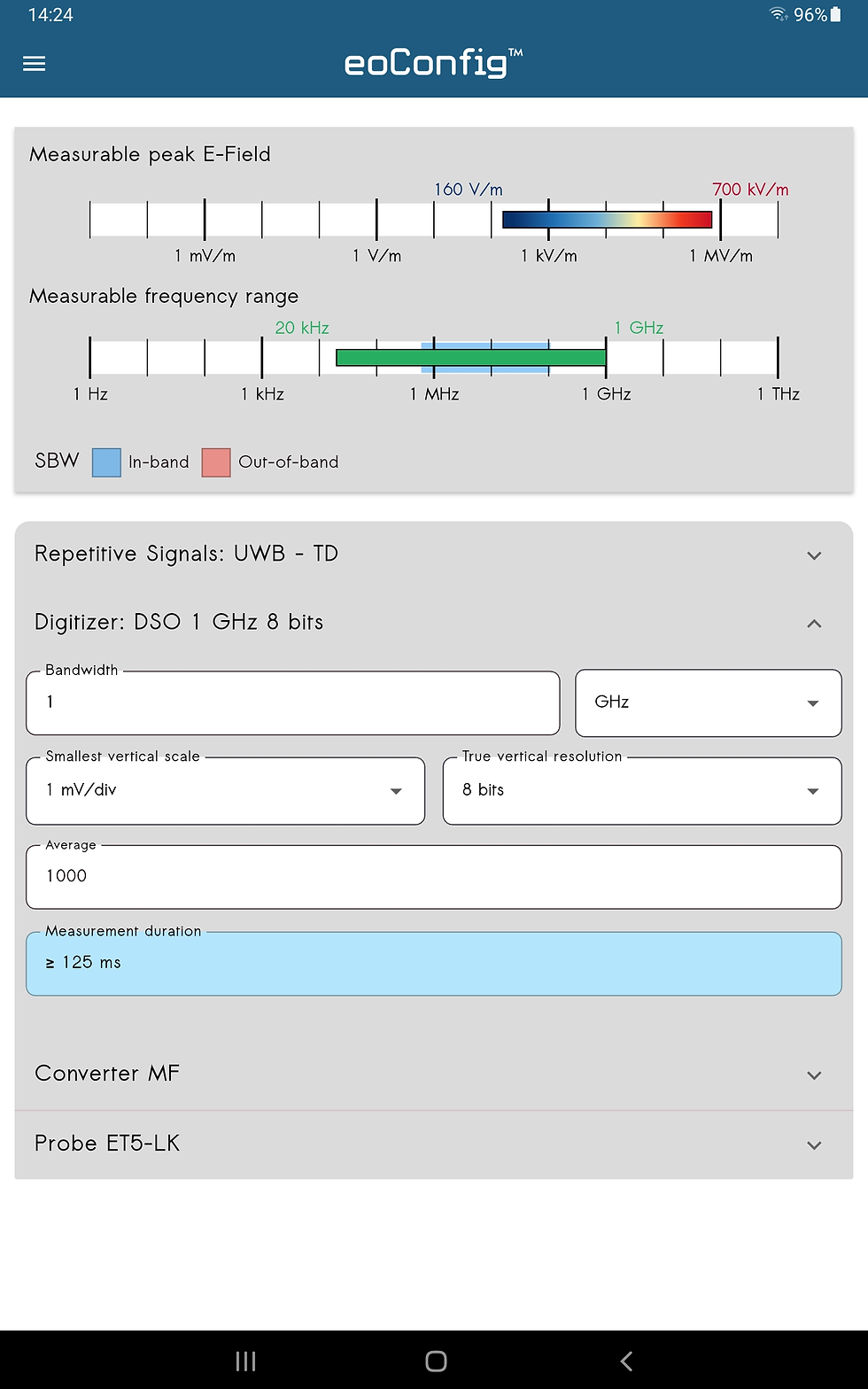
The smartphone/tablet application eoConfigᵀᴹ is a configuration tool that gives the range of measurable EM-field strength (either E-field or H-field) with respect to the experimental configuration including:
the characteristic of the signal to be measured,
the used EM-field probe and Opto-Electronic Converter -OEC-,
the used digitizer (ASA or DSO) and its settings,
any additional filter inserted in between OEC and digitizer.
Type of considered signals and results
eoConfigᵀᴹ allows simulations of measurement carried out in both time-domain and frequency-domain. The considered signals may be:
Continuous Wave -CW- signals,
gated CW pulses (i.e. ultra narrow band signals),
chirped pulses (i.e. narrow band signals),
wide band pulses (with no DC content),
ultra wide band pulses (monopolar signals with DC content).
Considered pulses can be either repetitive or single shots.

eoConfigᵀᴹ gives in real time:
the measurable EM-field strength (minimum and maximum values with indication of limitation due to digitizer if any),
the measurable frequency range (minimum and maximum frequencies with indication of limitation due to digitizer or filter if any) and the signal spectrum being either in-band or out-of-band with respect to the considered OEC.
Optimization of performances
With eoConfigᵀᴹ, any experimental configuration and any type of signals can be simulated in order to check the measurement dynamic range in terms of EM-field strength and frequency range without wasting time making the calculations. Moreover, it helps:
either to define the best settings,
or to see which new probe, new OEC or new digitizer is required to reach the targets.
When settings lead to perfectly satisfactory results, the parameters can be saved in a file in order to be loaded later on.
User guide and video tutorial
With eoConfigᵀᴹ you get a user guide that gives:
the meaning of the used acronyms,
the reference document in which the types of signal and their related formulas are defined,
a link to a video tutorial that shows the use of eoConfigᵀᴹ for practical cases


Practical case of gated CW pulses in Time Domain
A first example is given in the video tutorial, considering repetitive gated CW pulses with the following features:
frequency of 2.45 GHz,
pulse duration of 10 µs,
repetition rate of 10 kHz.
Considering:
the measurement of the transverse E-field component with respect to the E-field probe axis,
the use of a 8-bits DSO with a 10 GHz bandwidth for the digitizer,
the data acquisition in real time, triggered by the signal itself,
a calculated E-field dynamic range of 35 dB is obtained (from 12.5 kV/m up to 700 kV/m).
Changing the DSO to a similar model, but with 10-bits resolution, triggering now the DSO by a part of the signal delivered by the signal source (via a coupler), making an average over 1 million samples and inserting a 3 GHz low pass filter in between the OEC output and the DSO input leads to a huge dynamic range of 99 dB! (from 8 V/m up to 700 kV/m).
eoConfigᵀᴹ has been developed exactly for that purpose: moving from 35 dB to 99 dB of measurement dynamic range through the settings optimization and giving to the user a real-time view of the impact induced by any change of parameter.


Comments